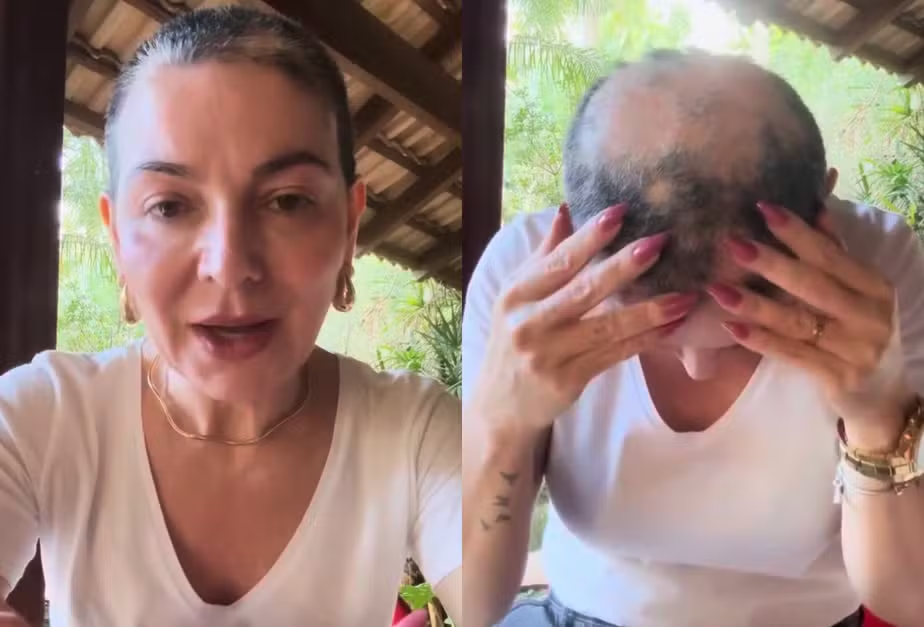
In recent years, the conversation about fillers has changed.
Previously, the appeal was for fuller lips, more prominent cheekbones, and faces with a more "filled" appearance. Now, the opposite movement is gaining traction: less excess, more visual naturalness, and more respect for individual facial structure.
This change didn't happen out of nowhere.
It was fueled by three main factors:
- regret with exaggerated results
- greater exposure of cases on social media
- The public's aesthetic maturation, which began to realize that rejuvenation is not the same as inflating the face, has also contributed to this.
It was in this context that several celebrities began to speak openly about dissolving filler injections.
Schedule your personalized evaluation with Dr. Renata!
Table of Contents
Why are so many celebrities dissolving fillers now?
The short answer is this: because the perception of beauty has changed.
Today, many patients no longer want a face that "looks made up." They want a rested, harmonious face that is consistent with their own anatomy. Vogue documented this "filler fatigue" trend, with less interest in flashy volume and more demand for subtle adjustments.
Furthermore, some women have begun to publicly report that:
- They felt they no longer recognized each other.
- They only noticed the excess after looking at old photos.
- They wanted to return to their own bone structure.
- They felt the result was artificial or heavy.
This discourse is very clear in accounts from celebrities who have chosen to dissolve recent or old fillers.
Does dissolving filler mean the procedure is bad?
No.
This is important. Dissolution doesn't mean that hyaluronic acid fillers are a bad procedure. It means that it's a medical resource that needs to be... well indicated, well planned and well executed.
Hyaluronidase, an enzyme used to dissolve hyaluronic acid fillers, is recognized as an essential tool for both correcting complications and reversing unsatisfactory results, such as excess, asymmetry, an artificial effect, nodules, or migration.
In other words, the problem is not "the fact that the information exists".
The problem usually lies in:
- wrong indication
- excessive volume
- indiscriminate repetition
- inadequate technique
- application by a professional without anatomical expertise
- lack of overall facial vision
Experts cited by Vogue emphasize that a large part of the poor results comes from incorrect positioning or excessive use of the product.
What is behind this trend of dissolution?
1. Exaggerated facial fatigue
Terms like "pillow face" became popular precisely to describe excessively voluminous faces, with a loss of natural contour. Vogue pointed out that this imagery helped fuel the cultural shift against excess.
2. Search for visual naturalness
Current aesthetic trends value "looking good" more than "looking full." This doesn't mean abandoning procedures, but rather using them with more discretion, less volume, and more sophistication.
3. Greater awareness of facial proportions
Many patients have realized that copying someone else's lips, cheekbones, or jawline almost never works well. Each face has its own bone structure, skin thickness, muscle dynamics, and aging process.
4. Correction of old excesses
In many cases, the procedure doesn't happen because the person "changed their mind," but because they want to correct build-up, migration, a heavy result, or a series of procedures that took away the lightness of their face.


Which celebrities have spoken publicly about removing fillers?
Several well-known names in Brazil have spoken publicly about removing, reversing, or reducing fillers due to excess, regret, or the pursuit of a lighter look.
Scheila Carvalho
Scheila Carvalho is one of the easiest examples for the Brazilian public to recognize. In 2024, it was reported that she decided to remove hyaluronic acid from her face after noticing an impact on the mobility and naturalness of her expressions. This case gained notoriety precisely because it represented this aesthetic change: less excess and more facial lightness.
Gkay
Gkay also entered this conversation in a way that was much closer to recent Brazilian reality. In 2025, she spoke publicly about overdoing procedures and about the decision to remove hyaluronic acid from her face after realizing she had gone too far. The account gained strength because it touches on an important point: sometimes a person only realizes the excess after they lose the reference point of their own face.
gaby martins
Gabi Martins is another well-known name among the Brazilian public who has expressed regret about fillers, especially in areas like her lips and chin. In interviews and publications, she said she felt she went a little overboard and described the reversal process and gradual loss of the effect, returning to a look she considered closer to her natural self.
Kylie Jenner
Even though she's not Brazilian, Kylie Jenner is perhaps one of the most recognizable figures to the Brazilian public when it comes to lip fillers. In 2018, she publicly stated that she had gotten rid of all her fillers, and this moment had a huge impact because it came from a celebrity associated with the popularization of this type of procedure. Therefore, she works well in this text as a widely recognized international reference.
What do these cases have in common?
The common thread is not that the form "went wrong" in all cases. What emerges strongly in these accounts is something else:
- perceived excess over time
- loss of naturalness
- discomfort with one's own image
- a desire to recover features more faithful to the original face
The problem isn't the filler itself, but rather when it's done haphazardly, without strategy, and without respect for individual facial features.
When the procedure respects anatomy, proportion, skin thickness, facial movement, and the patient's actual goals, the result tends to age better.
Does filler always need to be dissolved when it becomes excessive?
Not always. It depends on factors such as:
- product used
- treated region
- quantity applied
- time since application
- presence of asymmetry, migration or nodules
- aesthetic impact on the face as a whole
When hyaluronic acid fillers are used, hyaluronidase can be used for partial or total dissolution. Recent reviews highlight that it is an important tool in both elective situations and in cases of complications.
But dissolving something is also a medical act. It shouldn't be treated as something trivial or automatic.
How to avoid an exaggerated result?
Some principles make all the difference:
- avoid rushing
- do not treat the face in isolated parts
- Don't copy other people's mouth, chin, or cheekbones.
- prefer gradual construction
- Respect age, bone structure, and skin characteristics.
- Understanding that rejuvenation is not synonymous with volume.
The current public discussion about dissolution reinforces precisely this: patients are more cautious, more informed, and more interested in balance than in obvious transformation.
Is the future about no longer needing fillers?
Not necessarily.
What seems to be happening is not the "end of fillers," but the end of exaggeration as an ideal.
Experts interviewed by Vogue say that fillers are still in use, but with a different approach: less volume, more finesse, more contouring, and more combination with other strategies, such as lasers, radiofrequency, ultrasound, and collagen-stimulating treatments.
This makes sense because facial aging isn't just about loss of volume.
It also involves sagging, ligament changes, skin quality, bone resorption, and contour changes. If everything is treated with just a syringe, the chance of the face looking heavy increases.
Conclusion
The rise in celebrities dissolving fillers shouldn't be interpreted solely as a trend.
It reveals a deeper change.
People are tired of excess. They are more critical of artificial-looking faces. And they are understanding that well-treated beauty is not about drawing attention to procedures, but about respecting identity, proportion, and individuality.
The best approach is not to follow what an actress, singer, or influencer did.
It's about understanding what makes sense for your face.
Because fillers can be very welcome when indicated, technically sound, and appropriate. But when logic turns into exaggeration or repetition without strategy, correction becomes necessary.
-
Why are so many celebrities dissolving their fillers?
Primarily due to a shift in aesthetics. The excessively voluminous face has lost popularity, while the search for more discreet and natural results has grown.
-
Does dissolving a filler mean it went wrong?
Not necessarily. Sometimes it's about correcting excess, migration, or asymmetry. In other cases, it's simply an aesthetic decision to return to a lighter look.
-
Can all fillers be dissolved?
No. Dissolution with hyaluronidase is used for hyaluronic acid-based fillers.
-
Is hyaluronidase safe?
It is an important and widely used tool, but it requires proper medical and technical evaluation because it also has specific risks and indications.
-
What is the most important thing to consider before getting fillers?
Choosing a professional with anatomical expertise, aesthetic sense, sound judgment in making recommendations, and the ability to say "less" when necessary reduces the risk of overdoing it and later regret.


Medical evaluation is essential to understand the patient's complaints, identify dermatological problems, and consider their individual characteristics, such as anatomy, skin type, and reactions to substances used. Based on this, it is possible to determine the appropriate techniques to naturally enhance the features of the face, skin, and body.
Choosing a dermatologist is crucial for a thorough analysis of the areas of disharmony in the patient and to determine the necessary techniques, whether it be increasing volume, correcting angles, or symmetry. With a personalized and exclusive treatment plan, it is possible to meet the specific needs of each patient while respecting their limitations.
Dr. Renata Ralha, Clinical, Aesthetic and Hair Dermatologist, CRM: 52-84102-1 RJ, RQE No.: 28115

Medical evaluation is essential to understand the patient's complaints, identify dermatological problems, and consider their individual characteristics, such as anatomy, skin type, and reactions to substances used. Based on this, it is possible to determine the appropriate techniques to naturally enhance the features of the face, skin, and body.
Choosing a dermatologist is crucial for a thorough analysis of the areas of disharmony in the patient and to determine the necessary techniques, whether it be increasing volume, correcting angles, or symmetry. With a personalized and exclusive treatment plan, it is possible to meet the specific needs of each patient while respecting their limitations.

Dr. Renata Ralha, Clinical, Aesthetic and Hair Dermatologist, CRM: 52-84102-1 RJ, RQE No.: 28115

Follow our WhatsApp channel: Dr. Renata Ralha!
This channel is for you to stay up-to-date on the best news about... dermatology, aesthetics and skincareIn addition to finding out about all the new publications, promotions and sweepstakes that we offer at the Renata Ralha Clinic!